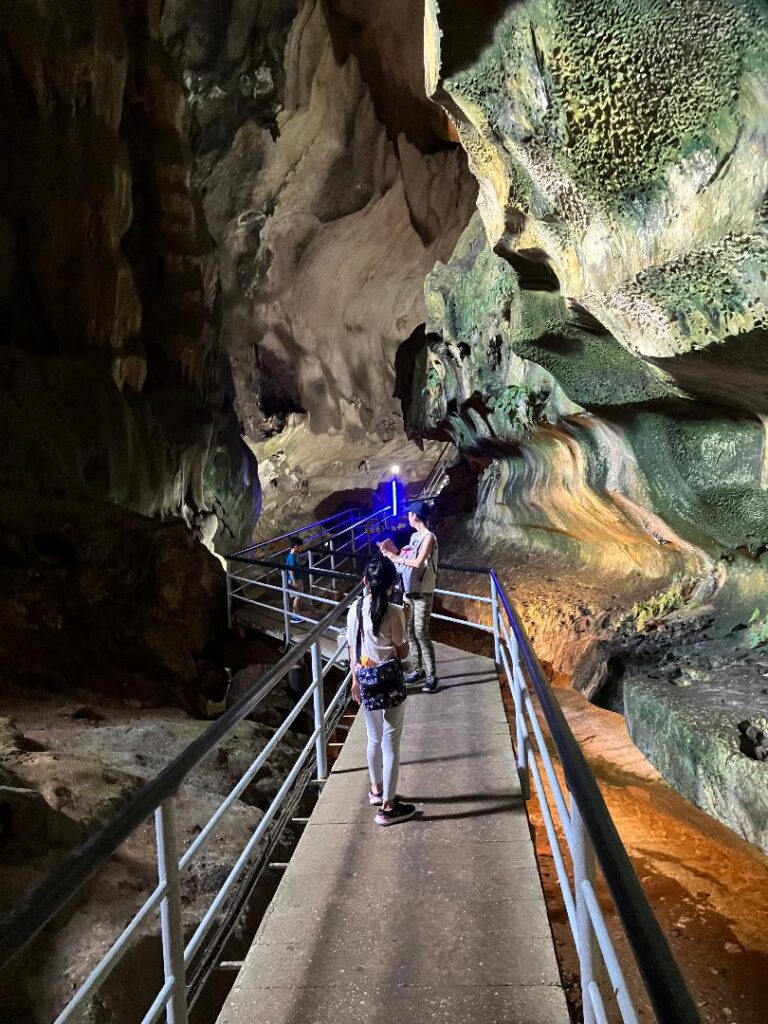
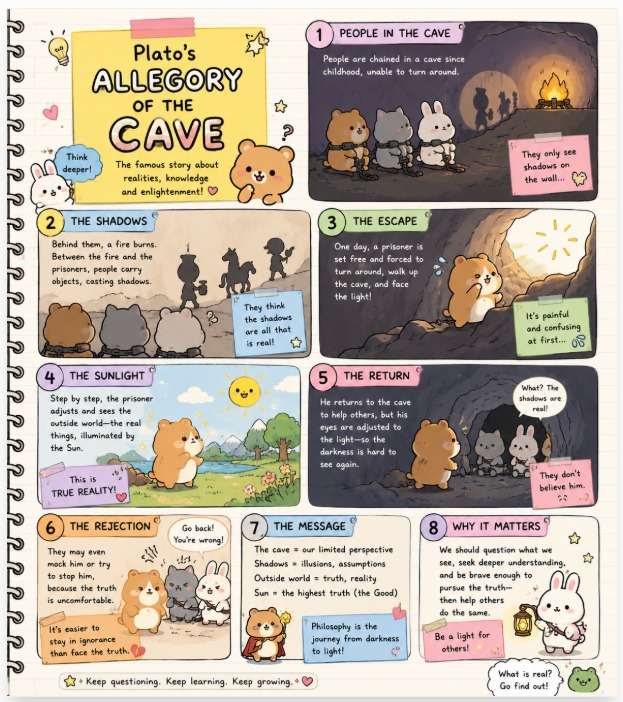
In Plato’s Republic, written around 380 BC, he describes a group of prisoners who have been chained inside a cave since birth.
They cannot turn their heads. Behind them, a fire burns. Between the fire and the prisoners, people carry objects — figures, animals, shapes — and their shadows are cast onto the wall in front of the prisoners.
The prisoners have never seen anything else.
So naturally, they believe the shadows are real. This is their world. This is their truth. The shadows have names. The prisoners have opinions about them. Some are even considered experts in reading the shadows.
One day, a prisoner is freed.
He turns around. The fire blinds him. Slowly, painfully, his eyes adjust. He is dragged out of the cave into the sunlight. At first he can only look at reflections in water — the direct light is too much. Gradually he sees trees, people, the sky. Finally, he is able to look at the sun itself — the source of all light, all truth, all reality.
He goes back into the cave to tell the others.
They don’t believe him.
They mock him.
If they could, Plato suggests, they would kill him.
The freed prisoner’s eyes have adjusted to sunlight. Inside the dark cave, he stumbles. He can’t read the shadows as fluently as those who never left. The other prisoners see this as proof that leaving the cave made him worse, not better. He has lost his edge. He is no longer one of them.
Plato’s point was never really about caves.
It was about comfort, and the social cost of truth.
People don’t stay chained to illusions because they are stupid. They stay because the illusions are familiar. Because questioning your entire worldview is disorienting and exhausting. Because the person who comes back from the light asking everyone to change is deeply inconvenient — and threatening to everything they have built their identity around.
When I explained this to my daughter on the way home from Pulau Ubin, she was quiet for a moment.
Then she said: “So it’s like how people know climate change is real, but it’s easier to just… not think about it?”
Exactly. She had arrived at Plato’s central insight in one sentence.
But here’s what I told her next.
Plato was an optimist at heart. He believed that if people could genuinely see the truth — really see it, not just hear about it — they would eventually choose differently. That knowledge, given time and the right conditions, leads to wisdom. That reason, properly cultivated, produces justice.
In other words: truth is painful, but it is also ultimately liberating. The freed prisoner suffers going from darkness to light. But once his eyes adjust, he would never choose to go back.
It’s a hopeful view of human nature. Difficult, perhaps, but fundamentally hopeful.
A Japanese manga series published more than 2,000 years later took a much darker position.
It asked: what if the freed prisoner finally sees reality clearly — and reality is even more terrifying than the shadows?
Back to Part 1 – My Daughter Asked a Question I Couldn’t Answer
One thought on ““What Plato Knew About Human Nature” Part 2 / 8”
Comments are closed.