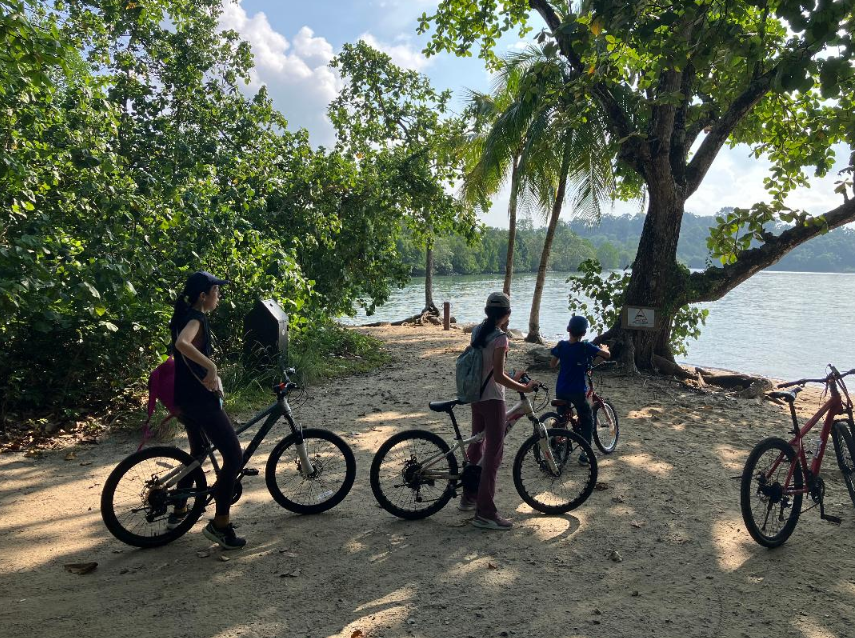
It started on a bike ride around Pulau Ubin.
We’d rented bicycles at the jetty and were slowly making our way along the coastal path — no traffic, no malls, just dirt tracks, mangroves, and the four of us pedaling at a pace that felt almost foreign after the usual rhythm of city life.
Halfway through, we stopped by the water to catch our breath. My daughter was looking out at the mangroves for a long while — quiet, which isn’t usually like her.
Then she asked, “Papa, why doesn’t Singapore have more places like this?”
I gave her some answer about land scarcity and development priorities. She wasn’t satisfied. She pushed further.
She’s been reading about climate change at school — the heat waves, the disappearing forests, the species going extinct — and something about standing in one of the last quiet, wild corners of our island brought all of it into sharp focus for her.
“People know it’s getting worse,” she said. “So why don’t they change?”
I didn’t have a quick answer for her. Because it isn’t a quick question. It’s actually one of the oldest philosophical problems in human history, dressed today in the language of climate science and vanishing ecosystems. But the tension at its core — between knowing and doing, between truth and comfort — has been with humanity for thousands of years.
I told her about a man who spent his life thinking about exactly this.
He lived in Athens around 380 BC. He was a student of Socrates, a teacher of Aristotle, and the author of one of the most enduring works in the history of philosophy.
His name was Plato.
And he told a story about a cave.
I said, “Let me tell you about it. And then I want to show you something from a manga series you might recognise.”
She looked up, curious.
That conversation on Pulau Ubin turned into something I’ve been thinking about for weeks. I want to write it out properly — not because I have all the answers, but because the questions my daughter is asking are ones I think all of us need to be sitting with right now.
This is Part 1 of an eight-part series. Each part builds on the last. Over the coming weeks, I’ll walk through Plato’s Cave, Attack on Titan, climate change, the psychology of “never having enough,” Keynes’ broken promise about the 15-hour workweek, and finally, what I’m personally trying to build with everything I’ve learned about having enough and minimalism.
Continue to Part 2: What Plato Knew About Human Nature →
One thought on “My Daughter Asked a Question I Couldn’t Answer”
Comments are closed.